Showing posts with label genealogy. Show all posts

Wednesday, November 24, 2021

Considering DNA Testing for Genealogy?


Considering DNA Testing for Genealogy?


With the holidays, most of the leading genealogy DNA testing companies have their kits on sale.
Before you splurge for the cost of one, for yourself or as a gift, make sure you are aware of possible consequences.
On December 1st, the Library is offering a one-hour class on the basics of genealogical DNA testing, the types of tests, and a comparison of the five major testing companies: 
  • 23 and Me
  • Ancestry DNA
  • FamilyTree DNA
  • Living DNA
  • MyHeritage DNA.
See examples of ethnic origin and relative finder reports from each of the companies.
Most people don't put much thought into testing before they swab their cheeks. This class urges you to think before you buy.
The class is from 6:30-7:30 p.m. 
Sign up HERE.

Wednesday, November 17, 2021

Beginner's Kit & Basic Genealogy DNA Class

 by Kathy Petras
New incarnation of the Family History Guide

Introduction to Family History: a guide for beginners

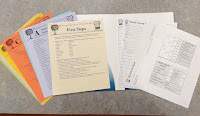
The Beginner's Genealogy Kit provided to novice family historians by the Library has undergone a transformation. Restyled as an Introduction to Family History: a guide for beginners, it has a more polished look and is now a booklet. The previous kit was a collection of handouts inserted into a folder.  
Previous Beginner's Kit


The new Guide covers the six major steps of beginning family history research:
  1. Getting Started - with whom do you start?
  2. Searching Your Home - what you already know.
  3. Write Down What You Find - forms, formats and documenting what you find.
  4. Interview Your Relatives - getting the most from their knowledge.
  5. U.S. Census Records - documents where your ancestors lived and when they were there. Contains clues as to where to look for other documents.
  6. Search for Vital Records - official documentation of the most important or "vital" events in everyone's life.
The Guide also contains many tips for organizing your records and covers special topics such as DNA Testing. 

Stop by the service desk in the Virginia Wheeler Martin Family History & Learning Center on the second floor of the Medina Library to pick up a copy or access it online at: Introduction to Family History: a guide for beginners

Considering DNA Testing for Genealogy?


With the holidays, most of the leading genealogy DNA testing companies have their kits on sale. Before you splurge for the cost of one, for yourself or as a gift, make sure you are aware of possible consequences.
On December 1st, the Library is offering a one-hour class on the basics of genealogical DNA testing, the types of tests, and a comparison of the five major testing companies: 23 and Me, Ancestry DNA, FamilyTree DNA, Living DNA and MyHeritage DNA.
Most people don't put much thought into testing before they swab their cheeks. This class urges you to think before you buy.
The class is from 6:30-7:30 p.m. 
Sign up HERE.

THE BLOG IS TAKING A SABBATICAL NEXT WEEK FOR THANKSGIVING DAY

IT WILL RETURN ON DECEMBER 1ST.


Wednesday, October 20, 2021

Genealogy Slam!

 October is Family History Month
And time for the VWM Center's bi-annual
GENEALOGY SLAM!


This time of year, the Genealogy Team routinely fields questions from homeowners wishing to research the history of their home and its previous owners. Particularly those prior occupants whose presence is still felt in their home.

Join the team as we explain how to:
  • Research your home's history.
  • Research the people who have lived in your home.
  • Use maps to enhance the history of your home.

Saturday, October 30th from 1- 4 p.m.

You have the option of attending in person or via Zoom by signing up HERE.


Thursday, August 5, 2021

Genealogy Discussion Group


The Genealogy Team is delighted to launch a monthly genealogy discussion group at noon on the 2nd Wednesday of each month.
 
Starting August 11th in meeting room 2A on the second floor of the Medina Library, The Genealogy Team, Lauren Kuntzman, Kathy Petras, and Lisa Rienerth, will be available to discuss research, share hints, and ask questions. Crow about your latest success story or we can share feedback on your stalled research. 

Can't make it on the 11th?

The discussion group will also be held noon on:
  • 8 Sep
  • 13 Oct
  • 10 Nov
  • 8 Dec
  • 12 Jan 2022
  • 9 Feb
  • 9 Mar
  • 13 April
  • 11 May
Connect with fellow genealogists. Learn from other's experience and mistakes. All are welcome!


Meeting room 2A and 2B on the 2nd floor of the Medina Library next to the Reference Desk.


Wednesday, July 28, 2021

InterLibrary Loan - Return of a Popular Service

During the COVID-19 crisis, interlibrary loan (ILL)  services at the Medina County District Libraries (MCDL) was put on hiatus. The service was quietly reinstated a few months ago.

BUT, at the Library Board of Trustees' meeting on July 19th, the Board members voted to rescind the $5 processing fee that was enacted in 2009 when the State of Ohio budget slashed funding to public libraries.* 


The "old" interlibrary loan form.
The $5 processing fee was charged whether you received the material or not.

As of the 19th, MCDL is now accepting new requests for interlibrary loan (ILL) for materials held by continental U.S. libraries with NO processing fee attached. Some lending libraries charge to borrow these materials up to a $15 maximum. Or you can opt out of paying any borrowing fees and MCDL will only request the item from libraries that do not charge a fee. 

Once you have placed a ILL request, it can take a couple of weeks for MCDL to receive the item from the owning library.

What types of materials can NOT be requested through ILL?

  • If the item is available to checkout at any of the CLEVNET consortium libraries, including all of the MCDL branches.
  • Anything that was published in the last year (current year copyright)
  • Rare, valuable items. For example, the first edition of James Audubon's Birds of the America which sold for $13.8 million in 2010. Don't try to request it!
  • Items that don't travel well, like a rare and fragile Ella Fitzgerald album.

Types of genealogy related items that can be requested:

  • Family Bible with births, deaths
    and marriages registered.
    Family histories 
  • Family Bibles                                                                   
  • Diaries or journals 
  • County or state histories 
  • Atlases 
  • Autobiographies 
  • Government records 
  • Meeting minutes or proceedings 
  • Indexes to birth, death or marriage records 
  • Church histories


How do you find what materials are held by libraries across the country? 


WorldCat is a network of libraries across the world that lists the member libraries' materials and often agrees to share them with other member libraries.

Learn how to use WorldCat by watching this short video:  


REMEMBER: 
  • Decide if you are willing to pay a fee from the lending library.
  • Provide complete information on the item you want: title, author, publication year, etc.
  • Let the Library Staff know if you are willing to accept photocopies only.
  • Be specific about what information you want to find. If you are able to accept photocopies, provide an individual's or a family's name, location, and time period.
  • Be patient.
  • If you have any questions, you can call the Medina Reference Desk at 330-725-0588 extension 2030.


Oh, and that "old" paper interlibrary loan form pictured at the top of the screen?  It has been replaced by an online form that library staff fills out for you!


*2008-2009 the state and the country experienced a severe economic depression. In order to continue the service the Board decided to pass the processing costs onto members using the service.

Wednesday, July 7, 2021

Most Overlooked Family History Resource - Periodicals


Family Tree Magazine, Internet Genealogy and Your Genealogy are just three of the family history
 related magazines that Medina County District Library subscribes to.

Most public libraries invest money and precious space to their magazine collections. And that holds true for genealogical collections too. 

However, to the dismay of family history librarians, the magazines are not used much by our members.

We get it. Finding time to read magazines is hard. Four magazines are sitting on my desk right now waiting for me to "have a spare moment" to read them. 

But if we make the time for them, we can get so much out of them!

How they can help our research

  • Their articles cover research methods and sources to broaden our genealogy education
  • They offer the opportunity to discover the history & people of a location
  • They reveal what resources historical and genealogical societies have
  • They provide a place to pose questions and get help tackling that brick wall

Genealogical publications can be classified into several categories

 Magazines/journals  

  • General interest magazines - Like the ones pictured above feature many how to articles on general, ethnic and foreign research. Just in these issues items covered are:
    • Scanning your photos & documents
    • Italian Roots
    • Pennsylvania Research Guide
    • African American Research
    • US Social Security & Delayed Birth certificates
    • And much, much more!
  • Regional- the magazines below cover regional topics, specifically, Ohio family history research, Ohio history, and New England ancestry. Articles include:
    • Cases where DNA has upended people's identities
    • Letters from an ancestor who had participated in the Women's Club movement
    • An interview with author, Conrade C. Hinds about his book Lost Circuses of Ohio
    • The restoration of the Warren G. Harding home and construction of his presidential library in Marion, Ohio
    • "Women on the Ohio Canals", and
    • "Ohio Civil War Veterans Buried in DeKalb County, Illinois"
  • Scholarly - journals, like The Register,  present case studies of New England ancestor's using the most stringent research criteria. It is a great learning tool for resolving brick walls and conflicting data. This issue contains articles on:
    • "Excommunication of Mayflower Passenger William White..."
    • "Sorting Out Several Daniel Lanphear Men"
    • "The Second Wife of Moses Gile of Hampstead, New Hampshire; Which Mary Clark?"
Ohio Genealogical Society Quarterly is the OGS' journal that comes with membership
in the Society. Echoes comes with membership in the Ohio Historical Connection. And
American Ancestors is part of membership to the New England Historic Genealogical 
Society (NEHGS). 


The Register is another publication
from NEHGS that is more scholarly.


Newsletters - are more casual publications than magazines or journals. They tend to have a limited audience, aren't printed on glossy paper, and don't have bindings. But don't underestimate them! They are published by:

  • Historical/genealogical societies
  • Libraries
  • Counties/regional/state societies
  • Surname/family groups
  • Ethnic/nationality populations
Spencer Town Crier, Past Pursuits, The Medina County
Story, The Medina County Historical Society
(formerly
Smart Talk) and the Chatham Historical Society Newsletter.


These newsletters are in the local history collection at the Virginia Wheeler Martin Family History & Learning Center at the Medina Library.

They inform about local happenings and recount historical events. Local genealogical society newsletters often have a section where you can post queries and get responses from local historians. Past Pursuits is the newsletter for the Special Collections Division of the Akron-Summit County Public Library.  They highlight their databases, list when new materials they've acquired and list any special events or classes at the Library.


PERSI - 
is the PERiodical Source Index created by the Allen County Public Library in Fort Wayne, Indiana. They index genealogical and historical magazines and newsletters from around the world. Want to know if there are articles in Colorado publications about your ancestors? Run a search through PERSI. Once you find an article you want, you can get it directly from Allen County or use your local library's interlibrary loan service. (There may be a fee for this service.) PERSI is available on FindMyPast. The easiest way to access it is to type "findmypast persi" into your favorite search engine. 

Online magazines/journals - some magazines don't require a trip to your local library or bookstore to check out and read. They are available:                                                                        

  • Through online personal subscriptions or memberships
  • Through popular reading apps, such as Overdrive and Flipster which are available through your local library.


Wherever and however you find them, genealogy magazines, journals and newsletters are an invaluable resources that you cannot afford to skip!

Wednesday, June 9, 2021

Mortality Schedules - an Alternative to Death Records

Photo courtesy of Linnaea Mallette on PublicDomainPictures.net

Death records of our ancestors are one of the primary sources that family historians are constantly searching for. They can lead to information on other family members, burial sites, cause of death and estate records.

Formal death records are usually available from 1900 onward in the U.S.. A few states, like Ohio, started recording death information in the latter half of the 19th century. Most New England states recorded all vital records much earlier. Tombstones and church records are often used as substitutes for formal death records. 

But what if death record, tombstone or church records aren't available?

Another possible substitute is the Federal Mortality Schedules, if your ancestor died in the 12 months prior to the enumeration of the U.S. Federal Censuses in 1850, 1860, 1870, 1880 and 1885. 

The federal government wasn't receiving information on deaths from the states and they wanted to know causes of death and if certain ages or occupations were more susceptible.  With the Mortality Schedules, the national policy makers had countrywide death statistics for the first time.

What information do they contain?

The information found in the schedules varies with the year and the caprice of the individual enumerators. 

1850-1860 - also only place a slave ancestor's death might be recorded

  • Name 
  • Age at last birthday
  • Sex
  • Race - free or slave
  • Marital status
  • Place of birth
  • Profession, occupation, or trade
  • Length of residence in county
  • Month in which person died
  • Disease or cause of death
  • Number of days ill


1850 Mortality Schedule from Mecklenburg County, North Carolina
NOTE: the red arrow indicates column where free/slave status is listed.
Accessed from Ancestry Library Edition on 7 June 2021.

1850 Mortality Schedule from Woodford County, Kentucky.
This enumerator chose NOT to list enslaved people by name.
Accessed from Ancestry Library Edition on 7 June 2021.

Excerpt from the 1860 Tuscaloosa County, Alabama Mortality Schedule.
Accessed from Ancestry Library Edition on 7 June 2021.

1870
  • If father and/or mother were foreign born
  • Removed the question about how many days the deceased was ill
  • Family number included which ties the entry back to a specific entry in the population schedule. (If it was filled in.)

Excerpt from 1870 Mortality Schedule for Brooklyn, King's County, New York.
Note the columns for if Father or Mother was foreign born. Also note the number of people
who died of contagious diseases, as might be expected in crowded conditions.
Accessed from Ancestry Library Edition on 7 June 2021.

Excerpt from 1870 Mortality Schedule for Cedar Township, Black Hawk County, Iowa.
Note that the individual on the first line does not have a family number associated with her.
Sylvia MUNSON, died in October 10, 1869 (underlined in red) but she was associated with family 
number 85 (red circle) in the 1870 Population Schedule.
Accessed from Ancestry Library Edition on 8 June 2021.

Family #85, Levi and Lucy Ann MUNSON is the household where Sylvia (above) was living at the time of 
her death. Is there a familial relationship?
Accessed from Ancestry Library Edition on 8 June 2021.

1880
  • Place of birth of mother and father
  • How long they had resided in the county
  • Where the disease was contracted if not at place of death
  • Name of attending physician
  • Family number included which ties the entry back to a specific entry in the population schedule. (If it was filled in.)
Excerpt from the 1880 Mortality Schedule for Guyan Twp., Gallia County, Ohio.
John Williams died at the age of 84, the oldest person listed on the page. He and his parents were born in "Virginia". This 
is important because at least one other source lists his birthplace as Pennsylvania. He had resided in Gallia County for 64 years,
giving him an arrival date of 1816, a few years later than the county history claimed. The family he was living with was 
numbered #149
Accessed from Ancestry Library Edition on 8 June 2021.

Strangely, Ancestry Library Edition did not have the image for family #149. There was a gap in their scanned images, jumping from family #143 to #195, and from page 16 of the enumeration schedule to page 23. The image below was taken from FamilySearch.org:

Who is this Rucker family? What is their relationship to John WILLIAMS? Is Susan RUCKER, John's daughter?
Accessed from FamilySearch.org 8 June 2021

1885
  • The Federal government offered to partially reimburse states that wanted to take a census in 1885. Colorado, Florida, Nebraska, and the territories of Dakota and New Mexico participated. However, the territories' mortality schedules are not on Ancestry, FamilySearch or Heritage Quest.
The 1885 Mortality Schedule looks like the earlier ones, but was taken only 5 years after the 1880.
Few states took advantage and even fewer of the schedules survive.
Accessed from Ancestry Library Edition on 8 June 2021.


Where do you find Mortality Schedules?

Ancestry - both Ancestry.com and Ancestry Library Edition


Once you have accessed Ancestry, either through your personal subscription or at a local library, click on Search on the menu bar.


Choose "Census & Voter Lists" from the drop down Menu.


From there, look to the right under "Narrow by Category"


Choose "U.S. Federal Census Collection".


Next scroll towards the bottom and choose "U.S. Federal Census Mortality Schedules, 1850-1885"


That will take you to the page for the schedules. From there, you can browse by selecting year, state and county, or use the main search area to search for an individual name.


HeritageQuest - always free from home by using your library card


HeritageQuest is owned by Ancestry.com and operates in the same way. It does not have all the same data sets as Ancestry, but is a great at-home alternative for census records. 

Once you have accessed HeritageQuest, click on the link on the home page to search the Mortality Schedules. 


FamilySearch 


FamilySearch.org is the free genealogy website provided by the Church of the Latter Day Saints (Mormons) and is available anywhere there is internet access. It requires that you sign up for a free account to view many of the images. No, the free account does not come at the price of being inundated by commercials.
Once you are at the site, choose "Search from the menu.


From the drop down menu, choose "Catalog"

In the "Place" search bar, type in "United States, " followed by the state for your ancestor. Example:
United States, Ohio" and then hit the "Search" bar below.


That displays the page of all of the FamilySearch holdings for that state. Scroll down to the Census entries and choose the year you want.


In the sample below, "United States, Ohio - Census - 1880 (8)" is selected:


This screen shows the selections under that heading. Do not chose the item with an individual's name as the author because that refers to books and manuscripts, most of which have not been microfilmed or digitized. Choose the item where the author is listed as "United States Census Office".


Click on the camera icon to start browsing the digitized microfilm.

If the film is only available to view at a Family Search Affiliate Library, the little camera icon under "Format" will also have a little key next to it. To view this image, visit one of the Medina County District Library branches.

If the Mortality Schedule isn't on any of the big genealogy sites, try these depositories:
  • National Archives - the National Archives has microfilm copies that usually can be ordered. Check out the microfilm catalog in the "Where to Find these Records" box on the right.  Forms that show the column headings for the Mortality Schedules can be found HERE.
  • State historical societies, archives and state libraries. (pp. 24-25 of Stephen Charter's work listed below under Sources)
  • Printed indexes - Check WorldCat to see who owns it. Remember! Printed indexes are a last resort. You always want to see the full document for information not listed in the index.

Coverage/Completeness of the records 

  • These states' mortality schedules are NOT listed on Ancestry or Heritage Quest:
    • Florida
    • Indiana
    • Oregon
    • Rhode Island
    • Vermont, 1850-1860
    • Wisconsin, 1880
  • These states, while not listed on Ancestry/HeritageQuest, ARE HELD at FamilySearch.org:
    • Florida 1860, 1880
    • Indiana, 1860-1880
    • Wisconsin, 1880
  • Before the National Archives was created, the government offered the original mortality schedules to each of the states. If the state did not accept, the manuscripts were sent to the National Library of the Daughters of the American Revolution (DAR).
  • States that were still U.S. territories are not covered.
  • 1870 is missing for 7 states: Delaware, Florida, Indiana, Mississippi, Missouri, Ohio, Rhode Island, Tennessee.
  • The Census Bureau has a list of known coverage of the mortality schedules:  https://www.census.gov/history/pdf/mortality.pdf 

Mortality schedules are useful for documenting documenting Africa American, Chinese, and Native American ancestry as well as tracing epidemics and diseases.

Follow up the information found in the Mortality Schedules by searching for obituaries, mortuary records, cemeteries, and probate records. They can also provide clues to migration points and they supplement information found in the  population schedules.

And as with other census and vital records, your ancestors' deaths may not have been recorded.
 

Sources:


Wednesday, June 2, 2021

Genealogy & Local History Help


 With the lifting of the social distancing mandate, the Virginia Wheeler Martin Family History and Learning Center at the Medina Library is happy to welcome back one of our favorite services - Genealogy One on Ones.

Before the pandemic, The Center offered two services for family and local history researchers: 

  • The Genealogist is In! which was offered for four hours on Tuesday afternoons. Staff would be guaranteed to be on hand to help with more in-depth research. Sometimes no one would show up and sometimes 3 people would all show up at the same time. It wasn't predictable and the best we could do was promise to spend at least 30 minutes researching the problem. Currently, the Center has two genealogists on staff, so the Genealogist is ALWAYS In! However, we cannot guarantee how much time we can spend with you.


  • Genealogy One on Ones was our version of the popular Reference-Service-by-Appointment geared to our specialized family and local history researchers. We offered it as a virtual service during the pandemic with limited success.
The old form for requesting a One-on-One appointment


Now it is back!

We are thrilled to be able to offer this service again. If you are interested in assistance with your genealogy or local history question, contact us:
  • 330-725-0588, extension 5017
  • me-team.genealogy@mcdl.info (copy & paste)
  • Or through this online form:  Genealogy Appointment 
Image from the online form.


To get the most from your appointment:
  • Be specific in your request. Provide
    • Individual's name
    • Location
    • Time period
    • What event are you searching? Birth? Marriage? Immigration?
  • By providing what information you already know and where you have already looked, we can better help you.
  • Each appointment is for one hour scheduled around our staffing levels and at a time convenient to you.
  • Part of each appointment is spent researching.
  • We suggest other areas of research. Not everything is available online. Sometimes you need to look elsewhere.
And yes, virtual appointments are still an option!


Ancestry Library Edition

Please visit our new blog address at: https://vwmfhcenter.blogspot.com/    A Basic Tutorial By Lisa Rienerth Before I begin with this librar...