|
A depiction of the first log school house in Medina, drawn
by an unnamed artist "of many years ago". First One
Hundred and Fifty years of St. Paul's Episcopal Church. |
In 1817, Medina County was on the country's western frontier. It's settlers were busy clearing fields and forests, fending off wild animals and scrabbling to survive. But they knew that education was very important to their children's future. So when the Episcopal church built a log cabin building, it soon became the site of the first school in the budding village of Medina. And the first teacher was Eliza Northrup. Neither the church/school or the teacher lasted more than a year. The log cabin burned down and the teacher married Giles Barnes and went on to have a long life and 7 children. But life as a married woman on the frontier left no time to be a teacher. (Learn more about Eliza HERE.)
Similar structures were soon popping up all over the county. Built as meeting houses, they served many purposes; places of worship, social centers, literary societies, singing schools, box
supper socials, debates, and schools. Most teachers were poorly trained and barely older than their students.
In 1825, Ohio legislated that all teachers had to pass a series of tests in reading, writing and arithmetic to qualify to teach. In 1847, another law was passed that required that school districts had to be formed within each county, setting up common (comparable to elementary) schools, and when population and need was sufficient, a central school. Parents wanting more advanced education for their children had to pay to send them to private schools called "select schools." These were equivalent to high schools today. Besides the cost of tuition, books, and often boarding, parents had to forfeit the time their children would otherwise be helping in the home or on the farm. It was a sacrifice many parents willingly made for their offspring.
 |
Map drawn by Cindy Allman illustrating Dr. Durham's
memories of Medina. The red stars show locations of
various select schools. Medina's Public School is located
in the red box in the lower portion of the map.
CONSIDER - How accurate could Dr. Durham's memory
be 55 years after the fact? |
In 1898, Dr Durham wrote a series of articles for the
Gazette about his memories of Medina as a 7 year-old boy in 1843. He and his father moved west to Iowa in 1845. SEE THE MAP TO THE RIGHT.
Later, there was one public common school and numerous private select schools.
The latter served as secondary education for those who wished to further their
learning and could afford it.
 |
| Photo courtesy of Google Maps |
By the time of the Civil War, Medina had three common schools, named East, North and South, according to their location, and one central school. All were wooden frame.
502 East Liberty Street was one of the three common schools in Medina from the mid 1800's. Built in 1837, it is the only one of the schools that still survives.
When the large central school was built in 1872, all the little schools were sold as residences.
Shortly after the fire which destroyed a large portion of uptown Medina in 1870, officials did an inventory of school buildings, which were all wooden frame. Perhaps in part due to safety concerns, they decided to build a new BRICK central school which opened in 1872.
 |
The new school pictured in the 1874 Combination Atlas Map of Medina County.
This all brick building, constructed for $19,000, housed elementary and high school students. |
When first built, the school did not have a lot of supplies and the students ran fundraisers to help furnish atlases, etc.
Professor H.N Carver established a Normal School (for training teachers) and rented two rooms of the new building for his classes. Students attending from the countryside boarded in the old wooden frame school building across the street. Carver's school closed in 1878.
This excerpt from the map of Medina Village from the 1874 Atlas shows the location of the Public School at north east corner of Smith Road and South Broadway.
The school later became known as the Lincoln School and was the high school from 1891 to 1924.
 |
| The Lincoln School from the 1897 Atlas of Medina County. |
 |
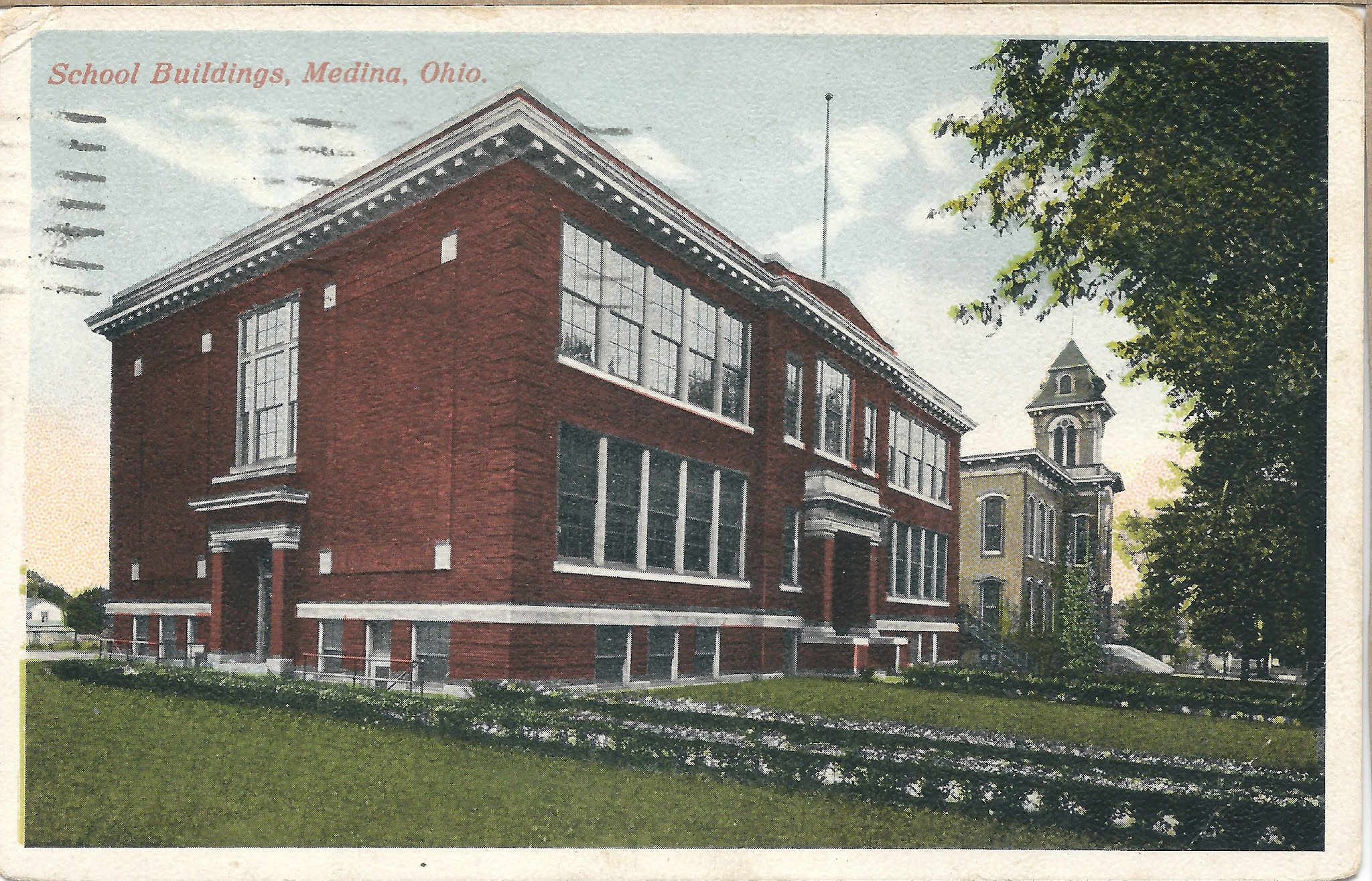
| The Lincoln School from an undated post card. |
Trees nearly obscure this photo of the Lincoln School in this undated post card.
It is not clear when the building stopped being called the "Public School" and when it started being referred to as the "Lincoln School."
By 1892, Medina's school population had increased so much that a new Primary school had to be built. This four room building housed the lower classes.
 |
This line drawing appeared in the Medina Gazette, 23 Jan 1891, (page 5)
celebrating the opening of the "Little School".
|
 |
| This undated postcard also depicts the Primary School. |
The building was on North Broadway in Medina, where the current Medina County Administration offices are. It was torn down in 1924. |
This picture of "The Little School" is from the 1897
Atlas of Medina County |
Around 1897, the first kindergarten classes in Medina were held in private homes. The classes were later moved to the "Little School" and Miss Ella Canavan was the teacher.
By 1911, population increases required another elementary school building just for the primary grades. The new 10 room building was constructed just north of the Lincoln Building and was christened "Garfield School".
These circa 1916 postcards show different angles of the new Garfield building. Notice the Lincoln School in the background.
Starting in 1914, a Normal School again began operating out of the Lincoln Building. Run by the county, the school churned out teachers until 1925 when legislature discontinued the Normal School system of teacher training in Ohio.
This snippet from the 1921 Sanborn Fire Insurance Map for Medina shows the line up of Medina Schools along Broadway; the Primary School on North Broadway (top of map) and then further down on South Broadway, first the Garfield Building and then Lincoln.
This lineup wouldn't last long, as the schools were already running out of room. A new high school was already in the works.
The decision was made to tear down the 1891 Primary School to make way for the new high school. The primary grades went into the 1872 Lincoln building and Garfield held the upper grades (equivalent to middle schools today).
From the 1926 Medinian yearbook, a look first at the old High School Building...
...then on the facing page, The New High School building.
Undated post cards of the Medina High School 1924-1973.
 |
| The postcard is undated, but the autos appear to be from the 1940's or early 50's. |
 |
| The Old High School building as it looks today as the County Administration Building. |
In 1950, the Lincoln building was torn down so that the Garfield Building could be expanded.
 |
| Demolition of the Lincoln School - Medina County Gazette March 17, 1950 Page 1 |
The expanded Garfield School included 26 new classrooms, a gymnasium, a cafeteria, a clinic and an industrial arts room. The building housed students from kindergarten to eighth grade and it opened in September of 1951.  |
| Garfield Elementary School in 2021. |
By 1956, Medina Schools needed to expand once again. A new high school was built on East Union Street. The old high school, on North Broadway, became the junior high school.
 |
Medina County Gazette July 6, 1956 Page 1
|
Aerial view of the construction of the new high school in 1956.
 |
| The artist's rendition of the new Medina High School appeared in the 1957 Medinian yearbook. |
 |
Sidney Fenn, Superindendent of Schools, standing at the entrance of the new school, standing .
Later, this school became the Claggett Middle School in honor of its first principal, Howard Claggett.
1957 Medinian. |
 |
| Claggett Middle School today. |
Read more about Howard Claggett's life HERE.
By 1960, building and population growth spawned a need for a second elementary school on the south west side of the city.
 |
Aerial view of the new school on Lawrence, just south West Park Blvd.
Medina Gazette 3 Oct 1960, page 1 |
Ella Canavan Elementary School, named after a beloved retired kindergarten teacher, opened on Oct 9, 1960.  |
Miss Ella Canavan taught generations of Medina kindergartners.
Medina Gazette 6 Oct 1960, page 1. |
Learn more about Miss Ella's life HERE. Crowding remained a problem and an addition was built onto the school in 1962-63.
The first elementary school library in Medina
was dedicated to “Miss Ella” in 1966.
Yet, another addition was constructed in the mid 90’s.
Crowding continued to be a problem and in 1965, a 2-story wing was added to the High School building (see Claggett School above.)
 |
| New elementary school under construction, Medina County Gazette, 28 Feb., 28, 1966 from Newspaper Archives. |
In September 1966, a new elementary school opened in the northeast part of town. named after Sidney Fenn, a well liked teacher, principal and superintendent, who had retired in 1961. But even before completion of the building, plans were drawn up for an addition to accommodate continued population growth.
 |
An aerial view of Sidney Fenn Elementary from the Medina Post 19 Sep 2016 when
the school was celebrating it's 50th anniversary.
|
To learn more about Sidney Fenn, click HERE.
Population growth continued to shadow the school system and in 1973 a new High school was built on East Union. It opened in April of 1973 and was built to house 2000 students. The old high school became the junior high and is now known as Claggett Middle School (See above).
 |
| Photo of the new high school in a special supplement of the Medina Gazette 18 April 1973. |
 |
| New High School auditorium in Medina Gazette 18 April 1973 - open house supplement |
Continued growth spurred the construction of a fourth elementary school, this time on the city's southeast side on Guilford Blvd. The land was donated by Ryan homes, one of the home developers that helped spur the growth. Also easing the financial burden, the school system sold the old high school building on North Broadway to the Medina County Commissioners. In honor of the nation's bicentennial, they named the new school Heritage.
 |
As the caption reads, the school "utilizes a flexible space.. concept. Room dividers can be moved
to alter the size and shape of the individual rooms." Medina Gazette - 20 Feb 1976 p. 1 |
With continued growth, the system looked at creative ways to easy crowding in the schools. So in 1990, kindergarteners were pulled out of their home schools and sent to a centralized kindergarten center in the old YMCA building on Weymouth Road. They filled in the swimming pool and set up nine classrooms. Sometime after 2003, the kindergarteners went back to their home schools and the space is now used for Board of Education offices. |
Once a barn, and later the YMCA swimming pool, this building served as the Kindergarten Center
for Medina City for over a dozen years. Now it houses the Board of Education Offices.
Cleveland.com 30 September 2019.
|
1995 - At the same time that the Ella Canavan school was getting yet another addition, a new middle school opened on the south end of town on 30 August 1990. Named after A.I. Root, Medina's eccentric and brilliant entrepreneur, the school was home to 692 students and students from Heritage and Ella Canavan were funneled through its doors. |
| First proposed in 1991, this layout of the new middle school appeared in Board Action Update, 17 Dec 17, 1991 |
The photo belies the headline in this Gazette article about the middle school's opening.  |
Three students cannot constitute a swarm.
Medina Gazette, 31 Aug 1995 p. 1 |
In 2001, H. G. Blake, yet another elementary school, opened up on the south east side of town. It is named after a very industrious and influential Medina businessman and politician. Read more about Blake's life HERE.
 |
| Medina Sun 16 Aug 2001 p. C-1 |
By 1997, the high school was already crowded as highlighted on the front of the Medinian Yearbook:
The 2002 graduates also used the yearbook for a platform for how they felt about attending school in the middle of a construction zone:
 |
| Students had trouble adapting to so many entrances, pictured below: |
The High School today...
Medina was still attracting an influx of construction and population. In 2008, to ease crowding at Sidney Fenn a sixth elementary school was built on Reagan Parkway. The area was problematic because it was part of city-owned Reagan Park. But the School Board swapped 7+ acres of school-owned land on Weymouth Road for the 7+ acres of parkland. The school is named for the first teacher in Medina, Eliza Northrup. Read more about Eliza's life HERE.
As population growth shifted to the south end of Medina, another elementary school was constructed on Cobblestone Drive. Mirroring the design of the Eliza Northrop School, the Ralph Waite Elementary School opened in 2013. Ralph Waite was a Medina business man who had dedicated his life to serving the Medina Community.
 |
Ralph Waite, who died in 2020
Cleveland Plain Dealer, Feb 19, 2020 |
A lifelong Medina resident, Ralph supported his community in so many ways. He served in the Army during World War II and was active in every Memorial Day Parade. He was on the Medina City Board of Education for many years and co-founded the Medina City Schools Foundation.
 |
| The Ralph Waite Elementary School is the mirror image of the Eliza Northrop School. |
Want to reminisce about your school days in Medina? The Medina High School Yearbooks have been digitized up to 1974 and are available HERE.
If you want the complete history of Medina City Schools, read Gloria Brown's book The Story of Medina's Schools 1817-2017
SOURCES:
- "The Educators: Eliza Northrup & Ella Canavan" MCDL Blog
- "Howard Claggett" MCDL Blog
- "Sidney Fenn" MCDL Blog
- "H.G. Blake" MCDL Blog
- "Historic East Liberty Street: A Virtual Walking Tour" July 2008.
- The
Story of Medina’s Schools 1817-2017
by Gloria Brown
- Pioneer History of Medina by N.B.
Northrop (1861)
- 1874 Combination Atlas Map of Medina County.
- 1897 Atlas of Medina County
- Historical Highlights of
Medina, ed. Eleanor Shapiro (1966)
- The First One Hundred and Fifty
Years of St. Paul’s Episcopal Church, Medina Ohio 1817-1967
- Sanborn Fire Insurance Maps, Medina County, Ohio, 1921.
- History of Medina by the Medina County Historical Society (1948)
- "Village of Medina Circa 1843", by Dr. Durham, illustrated by Cindy Allman.
- Highlights of Medina (1966)
- “Board Action Update: a Publication of Medina City Schools” 17 Dec 1991
- Cleveland Plain Dealer
- "Ralph E. Waite Obituary" Feb 19, 2020
- "Three Vie for Two Open Board Seats", 30 Sep., 2019.
- Medina County Gazette
- “Welcome to the Open House”, 18 April 1974.
- October 23, 1951 Page 3
- “Honor for Former Bus Driver”, 20 May 2009, p A-1
- "Students, Teachers Swarm to A.I. Root", 31 Aug 1995 p. 1
- "Heritage School Opens", 20 Feb 1976 p. 1
- "Open House Supplement", 18 April 1973
- "New Elementary School Under Construction", 28 Feb., 1966
- "Miss Ella", 6 Oct 1960, page 1
- "Aerial View of New Elementary School", 3 Oct 1960, page 1
- "New High School", July 6, 1956 Page 1
- "Demolition of the Lincoln School Building", March 17, 1950 Page 1
- "Medina's New School Building", 23 Jan 1891, (page 5)
- Medinian Yearbooks, 1926, 1957, 1997, 2002
- The Medina Post
- "Fenn's 50th Anniversary", 19 Sep 2016
- The Medina Sun
- “Blake Opening to Be Highlight of New Year”, 16 Aug 2001, p. C-1
- Jean Cooper Postcard Collection
- Google Maps
- "Beyond the Storefronts", MedinaSquare.org