Showing posts with label medina library. Show all posts

Thursday, October 14, 2021

Get to Know Your Local Historical Societies


Medina County is fortunate to have many societies dedicated to preserving our local history.  For the third blog post in this series, we’re featuring the Brunswick Area Historical Society. Sam Boyer, the society's secretary, answered our questions about the society. 


If you are interested in local history and/or have a family connection to Brunswick, below are some details about the history of the society and the programs and activities it offers. 


MCDL Library Associate: How did the society begin? Who were some of the early members? 

SAM BOYER: The Historical Society of the Brunswick area (it’s official name) became active in 1992. There had been an attempt at starting one in the 70s, but it never really gained steam. Some of the founders included Linda Scarcella, Ellen Gibbs and Aqua Neura. Shortly thereafter, Mamie Grunau became involved as the city of Brunswick began looking for a permanent home for a historical society.
 
They purchased a farm on Laurel Road after the death of Mary Groening, who purchased the farm in 1947. The city became only the fifth owner of the property, which was first settled in 1818. It now consisted of 32 acres. There was a deed restriction as Mrs. Groening was known to have driven off developers with a broom.

The city used a federal grant to renovate all the buildings before leasing them to the society in a partnership in which the society cares for the buildings and the city takes care of the property.

MCDL Library Associate: Who are the people who manage the Brunswick Area Historical Society? And what are their responsibilities? 

SAM BOYER: Current officers include three Brunswick High School graduates – Carl Bilski, president; David Goodyear, vice president; Joyce Petchler, treasurer. I am the secretary and have been a member for a long time, but became active when former president/vice president Amber Dalakas moved to Chippewa Lake. Ms. Scarcella continues to be active; Mamie, who is 97, is still in touch but not attending meetings now.

MCDL Library Associate: Tell us about your upcoming programs?  Where/when does the society meet?  Do people have to be members to attend?

SAM BOYER: We have tried several approaches to programs and just began a series on early families who have descendants still here. We heard from Carol Gannon and Nola Benjamin Lowther about their families, and we will have a program on the Chidsey family at 7 p.m. Oct. 28 at Goodyear’s Big Barn, 691 Pearl Road.

On Jan. 28, Chrissy Rhoades, the online storyteller about historic Brunswick, will be the guest and that meeting will be held at the Brunswick United Methodist Church, 1395 Pearl Road. We plan to continue with other families. The public is invited to attend. As of now we don’t charge, but do accept donations.

During the summer, meetings are held at 7 p.m. the last Thursday of the month at the Big Red Barn at Heritage Farm.
 
To help make what is now known as Heritage Farm more visible, we started a farmers’ market and it  ended its eighth year with the fall foliage tour this year.

MCDL Library Associate: If an individual needs help with research -- or if they live too far away to visit the historical society -- how can they get assistance?

SAM BOYER: We have been offline a couple of years as we continue to work to open a new building meant to house more than 200 years of school artifacts. We will also move our office from the very crowded second floor and then will offer online and in person access. 

We are always open to conducting tours of the farm by appointment, by calling 330-441-0292 or emailing brunswickareahistory@gmail.com. 

MCDL Library Associate: How can an individual join the society?  

SAM BOYER: Information about the society, how to become a member, upcoming events, and videos of past programs are available at www.brunswickhistory.com.

See more about the Brunswick Area Historical Society by clicking on this link:  https://www.youtube.com/watch?v=j8qPTm71mi0&t=22s

Thursday, August 5, 2021

Genealogy Discussion Group


The Genealogy Team is delighted to launch a monthly genealogy discussion group at noon on the 2nd Wednesday of each month.
 
Starting August 11th in meeting room 2A on the second floor of the Medina Library, The Genealogy Team, Lauren Kuntzman, Kathy Petras, and Lisa Rienerth, will be available to discuss research, share hints, and ask questions. Crow about your latest success story or we can share feedback on your stalled research. 

Can't make it on the 11th?

The discussion group will also be held noon on:
  • 8 Sep
  • 13 Oct
  • 10 Nov
  • 8 Dec
  • 12 Jan 2022
  • 9 Feb
  • 9 Mar
  • 13 April
  • 11 May
Connect with fellow genealogists. Learn from other's experience and mistakes. All are welcome!


Meeting room 2A and 2B on the 2nd floor of the Medina Library next to the Reference Desk.


Wednesday, July 21, 2021

Must Love Cemeteries...

How to be a Findagrave™ Volunteer


The warm weather is upon us and some of us like to enjoy it by walking through cemeteries. It is always beautiful and it can be very interesting and informative. If you are one of these people, then consider volunteering with Findagrave - many historians and family researchers would be grateful! 

The gravesites on this site are listed as Memorials and with those memorials are sometimes a photograph of the gravestone. This helps a researcher in two ways. First, the memorial has information on the person who is buried at the gravesite, such as birth and death dates. Second, if the photograph is also available it helps those researchers who cannot visit the cemetery in person either because of the distance or mobility issues. 

It is the memorials without photographs that need someone to take a photograph of the gravesite and upload it to the site. 


Interested? Here's how to help....

The first step is to register with Findagrave at findgrave.com. 


After clicking on "REGISTER", fill out the form and don't forget to check the box to become a photo volunteer!  You can click on "What is a Photo Volunteer" for a more in depth description.                        You will use this email and password to SIGN IN to the site. 


After signing in you can find out who is requesting a photograph by clicking on the camera icon on the home page.


This will take you to the request page. Click on the "Open Requests" tab and filter the search to either your home location or a different location and how many miles you are willing to travel.  A list of request will be generated.


It will show which requests have been claimed and which ones are still open. To claim it, click on the CLAIM button and start searching.  Be aware that if the flag to the left of the CLAIM button is red, this means someone has already searched for this gravesite and there was a problem with it. Click on the flag to see the problem. 


Once you have taken the photo you will come back to the request page and click on the FULFILL button. This will take you to the upload page.

Don't forget to read the photo guidelines. 


The person who requested this photograph will be notified by email that the photograph is now uploaded to their ancestor's Memorial Page.


 If you want to search for your relative's Memorial page use the search box on the home page. This will give a list of names to click on to navigate you to their memorial page. 


If your ancestor does not have a photograph of the tombstone on their memorial page, you would just click on the Request  Photo icon and it will be placed on a list for the volunteers in that area.
To upload your own photographs to the memorial it is as simples as clicking on the Add Photo icon and uploading it the same way you would when fulfilling a request. 


If yours search comes up empty you can also create a Memorial Page for your relative as long as you know where this person is buried.   First, you click on the Add a Memorial icon found on the Home Page.   


Find the cemetery's listing...


Then fill out the form and click on ADD MEMORIAL at the bottom of the page.


Once the memorial is created you can either upload your own photograph or request it to be filled. 


Findagrave also has a wonderful selection of video tutorials that help walk you through this and many of the other options available on the site. Just look for the tutorial icon at the bottom of the screen. 


Volunteering for Findagrave is both easy and gratifying. There are a few more sites which benefit from the help of volunteers, such as Billongraves and Ohio Gravestones. If you have the time and love visiting cemeteries, please consider helping those in search of their ancestors. 

You might also want to read our blogs on Research Trips and Cemetery Research before heading out to the cemetery! 


Thank you to Findagrave for allowing us to use images from the website. 


Thursday, April 1, 2021

Happy Anniversary Girl Scouts!

March marks the 109th anniversary of the Girl Scouts.  


In 1912, when U.S. women still did not have the right to vote, Juliet Gordon Low wanted young women to envision all the opportunities available to them. Emphasizing inclusiveness, the outdoors and self reliance, Juliette's girls: 

●  Hiked 

● Camped

● Swam 

● Played basketball 

● Learned to tell time by the stars 

● Studied foreign languages 

● Shared a sense of adventure & belief that they could do anything 

●Offered a helping hand to those in need 

●Made their corner of the world better

Low pinning a badge on a Girl Scout's uniform.
Circa 1912.


Still flourishing today, the Girl Scouts boast over 2.5 million members and over 50 million alums in 92 countries .


Girl Scout troops in Medina County are part of a regional group that has undergone many name changes. First they were called the Akron Area Scouts. Then they became the Summit City Council of the Girl Scouts. Then in 1962 they became the Western Reserve Girl Scout Council. Finally, in 2007 five regional Girl Scout Groups combined to become the Girl Scouts of Northeast Ohio.


Here's some highlights from the last 100 years of Girl Scouts in Medina County with emphasis on the early years of their development.

  • Miss Francelia Stuenckle
    German and Normal School Teacher*
    at the Medina High School.
    1917 -The first troop formed in Medina County was at the Medina High School in the fall of 1917. The United States had just entered World War I. Over 20 girls, all members of the junior class, attended the first meeting held at the Garfield Building (then the high school) in October. Miss Francelia Stuenckle was their scout master.
  • 1918 - The girls are avid hikers, trekking out to L.H. Randall's cabin and later to the Northern Ohio railway.
    • The sell tickets for the Red Cross Pageant, a fundraiser for WWI.
    • The Girl Scouts sell over $1600 War Savings Stamps^ That would be $28,000 in today's dollars. They do so well that the Boy Scouts back off from participating in the program.
    • The Girls jump into selling Thrift Stamps^
    • Miss Stuenckle returns to her hometown of Chicago and Miss Marion Whipple takes over the scouts.
  • 1919 - The Girl Scout presence in Medina County grows as Granger High School and Wadsworth form their own troops.
    • 19 girls attend camp for 10 days at Camp Mittawanda on Lake Erie. Several sets of parents visit their daughters at the camp.
    • In May, the Girl Scouts bring a group of Swiss Bell Ringers to Medina.
    • In December, they have a Christmas Party and later distribute Christmas baskets to the needy.
  • 1920 - The Girl Scout program expands into China, Syria and Mexico. In the U.S., Native American and Mexican American troops form. The Medina Troop spend 2 weeks at Chippewa Lake.
  • 1922 - The Lodi Girl Scouts spend a week at Camp Crag.
Started as a 4-H camp, Camp Crag welcomed many
Scout troops over the years.


  • By 1924, The Girl Scouts in the region had grown to over 20 troops with 700 members
  • 1925 - Sharon Township and Seville Girl Scout troops form.
  • 1930 - Girl Scouts collect food and clothing for those suffering the effects of the Great Depression.
  • 1932 - Camp Ledgewood opened up in Peninsula, OH

Camp Ledgewood is still used by Girl Scouts today.

  • 1936 - Two troops traveled to Camp Ledgewood.
    • The first "colored" troop forms in Medina. They are supervised by Mrs. Will (Sally) Ozier, who is also African American. Her husband supervised the Boy Scout "colored" troop.
    • The village of Medina has three troops of Girl Scouts.
  • 1937 - Disparities are seen; the "colored" troop were getting badges as "laundress", "housekeeper" and "needlewoman", while the other troops are receiving badges in "scholarship", "observer", "swimmer", "gardener", "child nurse" and "artist".
    • All 3 Medina troops attend Camp Crag
    • Medina Girls are getting the highest award. "Golden Eglet" status is awarded to Miss Mary Louise Long and Miss Ramona Everhardt.
  • In 1938, Troop 3, the "colored" troop is recognized by the Girl Scout National Headquarters.
  • 1939 - In the photo below, the girl in the second row, far right is Virginia Wheeler (Martin), who donated the money for the Medina Library Family History and Learning Center that bears her name. 
Oct 24, 1939  Medina Gazette p. 3


Virginia Wheeler's Girl Scout Badges:
Bird Watcher and First Aid
From the collection of Virginia Wheeler Martin.

Girl Scout image from circa 1940.
From the collection of Virginia Wheeler Martin.


Virginia Wheeler's Girl Scout Handbook
for the Intermediate Program, circa 1940
From the Collection of Virginia Wheeler Martin


  • 1940's - Nationally, Girl Scouts  supported the war efforts by operating bicycle courier services, running Farm Aide projects, and along with millions of other Americans, collecting fat and scrap metals and growing Victory Gardens. Internment camps in California and Utah saw the emergence of Girl scout troops among the imprisoned Japanese American girls.

February 9, 1940 Medina Gazette Page 4.
An appeal goes out to area agencies to plan for Civilian Defense.
    • Locally, Medina Girl Scouts sold movie tickets in support of war relief.
    • The decade saw many of the troops selling Girl Scout cookies for the first time.
  • 1950's Girl Scouts assembled "Kits for Korea" to distribute items desperately needed by Korean citizens.
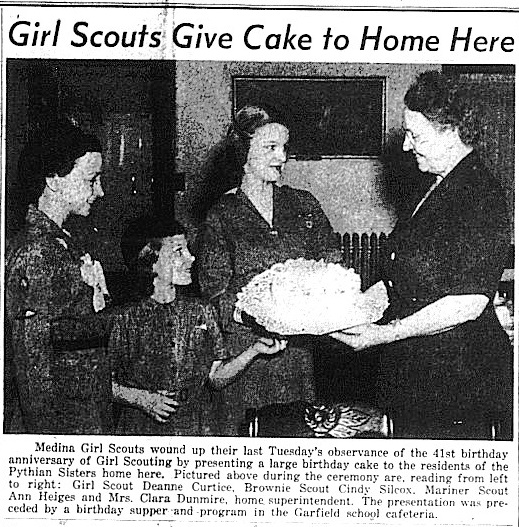
  • 1953 - Celebrating the 41st Anniversary of Girl Scouts
To celebrate the 41st anniversary of the founding of the 
Girl Scouts, the girls baked a cake and presented it to 
the superintendent of the Pythian Sisters Home.
March 17, 1953 Medina Gazette,  p. 1.

  • 1968 - Girl Scouts volunteer at the hospital along side Candy Stripers.
  • 1969 - Brunswick Senior Girl Scouts attend a national meeting at Kent State University where the following topics were discussed:
    • Learning to communication with other people
    • The War in Vietnam
    • Civil Rioting in the U.S. 
    • The males' view of sex, dating & marriage
  • 1969 in October the girls participated in a Dolly Derby, where they dressed the dolls and competed for best dressed. Later the dolls were given to Good Will to be sold in time for Christmas.

Green Leaf Park courtesy of Google Maps


  • 1972 - Local Girl Scout troops plant over 600 trees at the Sharon Gravel Pit Park. The park has since been renamed Green Leaf park. Today, you can't tell that it was once a gravel pit.


  • 1980's - They created the "Contemporary Issues" series  that addressed serious issues such as drug use, child abuse and teen pregnancy.


  • 1989 - Lodi Girl Scouts learn all the tricks of the trade in being a clown.
 February 27,  1989  Review Chronicle Page 10 


  • 1996 - The Girl Scout web site debuted and a Technology Badge was introduced.
  • 2000's focused on the healthy development of girls.
  • 2017 -  Girl Scouts help with the Children's Garden at Heritage Farm in Brunswick. 
    Girl Scouts Morgan Kulka and Lydia Miller work
     on the children’s gardens at Heritage Farm
    in Brunswick. (Photo Courtesy of Scott Miller)
    Cleveland.com

  • Natalie Bair
    Fox News

    2018-2019 - Medina Girl Scouts urge Medina City Council to ban plastic bags.
  • 2020 - 12 year old Natalie Bair received the Girl Scout Medal of Honor for saving her baby brother's life when he choked on a cracker while riding in the car.
  • 2021 - "Made with Code" program encouraged girls to work in computer science. Girl Scout cookies were sold online with "Digital Cookie"


Girl Scout COOKIES

In 1917, Girl Scouts in Oklahoma were baked the cookies themselves and sold them as a fund raisers. In 1922, a simple sugar recipe was shared in the Chicago Council. For years the girls baked and sold the cookies in simple wax paper wrapping.   The price? 25¢

A box of commercially baked Girl Scout Cookies from the 1930's

During World War II, sugar, flour and butter were rationed and in short supply. In 1944, the girls switched to selling calendars as an alternative.

After the war, cookie sales increased and by 1948, 29 commercial bakers were licensed to bake Girl Scout Cookies.

By 1951, the cookies came in 3 varieties; Sandwich, Shortbread with the famous trefoil imprint and Mints. By the 60's the bakers were wrapping the cookie boxes in aluminum foil or cellophane to preserve the cookies' freshness.

The cookie flavors have continually expanded and they now offer 12 varieties, including Trevoil/Shortbread, Thin Mints, Peanut Butter Sandwich and Samoas.

Which is your favorite? And how many did you order this year?


*"Normal School" was a teacher preparation course.
^Both the War Savings Stamps and Thrift Stamps programs were U.S. government projects to help fund the country's participation in World War I.

Thursday, March 4, 2021

Tips for Searching FindMyPast (+4 Record Sets You Should Explore)

Among the genealogy databases the MCDL offers, FindMyPast is often described as a collection of records for the United Kingdom and Ireland.  While FindMyPast’s collections are especially strong for this part of the world, there are many records for the United States, too.  


Tips for Searching FindMyPast

Tip #1 - Access FindMyPast from Medina Library only.  Any computer in the Medina branch should have access - or come visit the Family History & Learning Center for assistance.  Not all records are available with the library’s subscription, but it will get you access to a lot of their collections!  


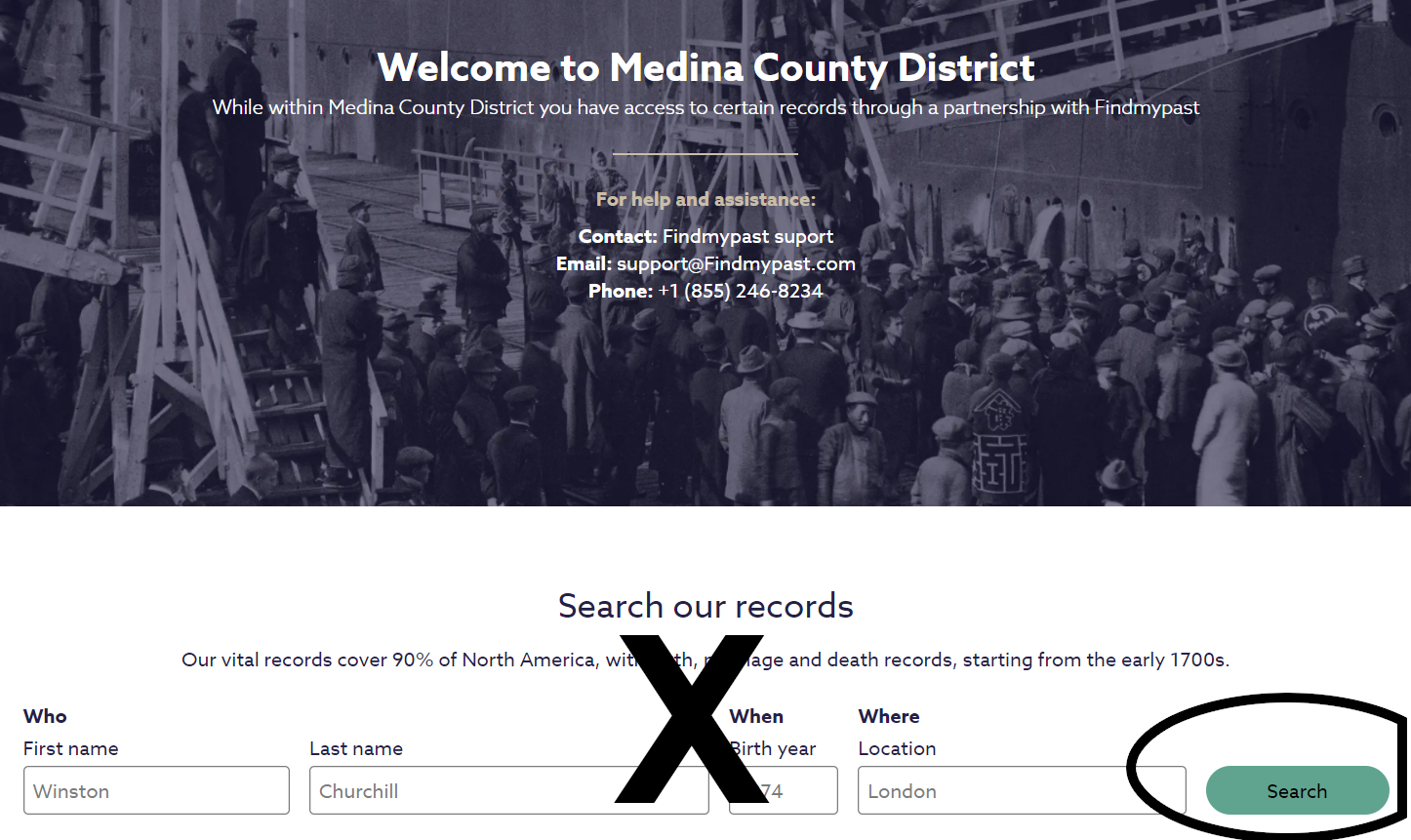
Tip #2 - Skip the (first) Search.  It sounds counterintuitive, but FindMyPast's first search screen isn’t that helpful!  Leave the fields blank and just click the “Search” button.  This will take you to a search screen with more options.  It will also give you the option to view all of the record collections that FindMyPast has to offer (see below).  

Leave the fields blank, and just click search. 


Use the search form at the left, or click "All record sets" to see the collections in FindMyPast.  A few collections are listed below that everyone should explore!


Tip #3 - Use the "Advanced Options" help features.  FindMyPast tries to get you the records you want.  For the best results, enter a minimal amount of information into the search form, and then filter the search results.  Filters for geographic locale and record types are on the left.  

Also, take advantage of the help they give you: Use “name variants” when searching names and use the terminology they offer you with the “Browse Category” lists.  All of these techniques will make your searches more efficient in FindMyPast.  


Explore these Record Sets


If you're new to FindMyPast, then it's time to get searching.  Here are four record sets that you may want to explore.  (At least two of them can only be found on FindMyPast!) 

1) United States Marriages

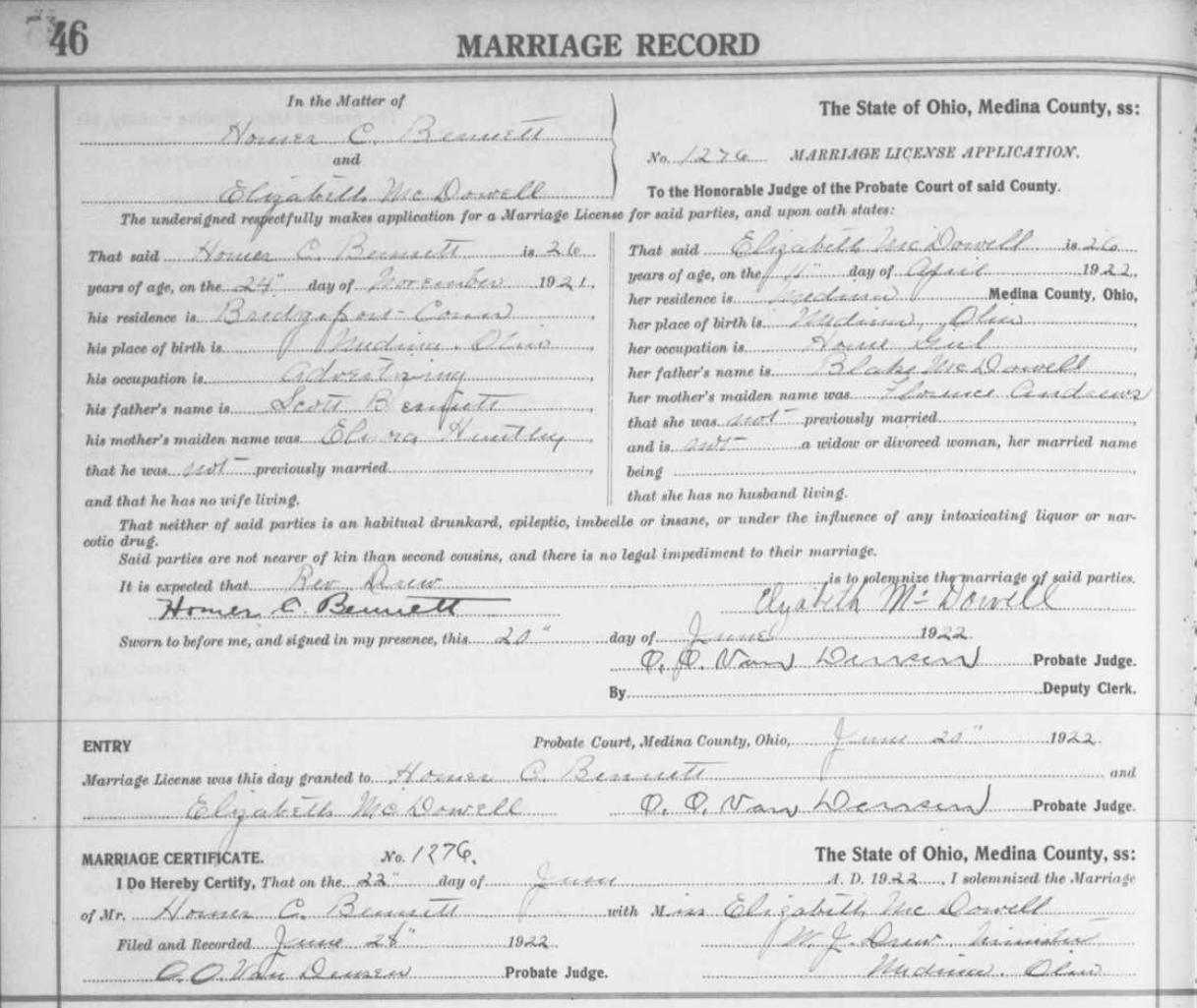
This collection includes records for over 200,000,000 (yes, that many zeroes!) from the United States, between the 17th and 20th century.  Records may include licenses, certificates, registers, bonds, newspaper announcements and other records.  Some of the records will be images of the original document, while others may be only transcripts.  New records are periodically added to the collection.  If you’ve been having trouble documenting a marriage, search this collection -- it may have the record you need!  


2) Passenger Lists Leaving UK 1890-1960

While many of us can find passenger lists when ancestors arrived at Castle Garden, Ellis Island, and other ports, it’s rare to find an outgoing passenger list for them.  This collection, found exclusively on FindMyPast has 30,000,000+ records for individuals heading to the U.S. and Canada.  (And remember, this isn’t just for British and Irish ancestors -- Eastern European immigrants sometimes stopped through an English port before traveling on to New York!) It’s worth a search, to see if you might be able to document the start of your ancestor’s immigration journey!  Learn more about this collection here.  


3) Census Records

While you can find census records in many genealogy databases, FindMyPast’s collection has different indexing and search algorithms than Ancestry or FamilySearch.  If you haven’t had luck in finding your family on the census, search for them again on FindMyPast. 


4) Roman Catholic Records

FindMyPast includes over 500 collections of Roman Catholic church records for dioceses in the worldwide.  In the United States, if your ancestors attended services in Baltimore, Chicago, Cincinnati, New York, Toledo, or Philadelphia, then you will definitely want to search these collections.  Most of these records are available exclusively on FindMyPast.  


Because it relies heavily on filtering your search results, searching in FindMyPast feels a bit different than searching in other genealogy databases.  If you find yourself getting frustrated or need any assistance, please reach out to the MCDL Genealogy Team at me-team.genealogy@mcdl.info or 330-725-0588 x2070 and we'll be happy to assist you.  


Wednesday, February 24, 2021

Family Group Sheets

 A Family Group Sheet is a work sheet to record information on a family.


While an ancestor chart presents multiple generations of ancestors, a family group sheet focuses on the details of a family; a set of parents and their children. 

A family group sheet is created for each couple that appear on an ancestor chart.

If an individual has had more than one partner, a family group sheet is created for each couple.

Additionally, a sheet is created for each child and their spouse or partner.

A good family group sheet shows:
  • The full names, including nicknames, of each person.
  • The dates and places of births of each person.
  • The dates and places of marriages of each couple.
  • The dates and places of deaths for each person.
  • Whenever possible, the sources of each piece of information is included.
Like the ancestor charts, family group sheets take many forms. Choose the one that best suits your needs.
Also, most genealogy programs create family group sheets as you build your family tree. Here are three examples.


From Ancestry.com

Notice the difference in the layout with the couple's parents' names listed above the couple. Also, the spouses/partners of the children aren't listed on this sheet.

This family group sheet is from the popular program Family Tree Maker. The inclusion of thumbnail photos is a nice feature.


This sheet is from another popular family tree software program,  Roots Magic. 


Like an ancestor chart, a family group sheet quickly identifies what information is missing on each individual. 

  • Look for events that are missing, i.e. birth, death marriage, etc. 
  • Look for events that need better documentation.
  • Look for events that need a more exact date.
  • Look for events that need a more exact place.
A family group sheet organizes in one place the information that is known/unknown about a family. 


Notice all the missing information:
  • No religion is listed for William Henry MASON or his wife Elizabeth HARMON. Church affiliation could lead to baptism, marriage or burial information.
  • No military service information for William. He was too young to participate in the Civil War, but would have been old enough to serve in the Spanish American War. However, by that time he was the father of at least 9 children.
  • The question mark after William's mother's name indicates that this information needs to be verified. It was listed on the death certificate of one of her children but no where else, as no marriage record has been found for his parents.
  • Florence and George have no information listed for their deaths or marriages. There are several possibilities:
    • The died before getting married. Death information for this time period and location is spotty. 
    • They might have been using a middle name instead of their given names. What do their initials stand for? Can any records be found under that name?
  • Marriage information for James Wilford and William Henry MASON is missing. There are numerous marriage records in West Virginia for these names.  More work needs to be done to detect which are the correct ones for these individuals.

How else can family group sheets aid your research?

  • It can help your correlate and analyze information. In the example above, could obituaries of their siblings lead us to discover the death information for Florence, and George MASON?
  • While filling in the family group sheet, you have to examine your original source again. The names of the children of this family group come from census records. Florence and George disappear from the family unit between the  1900 and 1910 census. Florence would have been when she was 16 years old in 1900 and 26 years old in 1910. Those are prime marrying years for girls of that time period. Now, we have a specific time period to look for either a marriage or death record. Also, we could look for a woman named Florence who was 26 years old in the 1910 census.
  • Build up more clues to help discover harder to document events. In looking at the 1910 Census again (for this post), we see that the mother Elizabeth says she has had 9 children, 6 of whom are still living. So now we know that most likely Florence and George died sometime between the 1900 and 1910 censuses.
  • Use blank family group sheets at family gatherings to help gather new information. This is particularly helpful for filling in the newest members for those families you don't get to see regularly.


Tips for filling in Family Group Sheets

  • Use a pencil to fill in the information so that it can be easily corrected.
  • Last names are written in ALL CAPITAL letter. 
  • Women are ALWAYS listed under their maiden names.
  • Fields listed as "Birth", "Marriage", "Death", etc, should have dates filled in.
  • Dates are entered day/month/year
    • Never use all numeral form
    • For example, "11 January 1999" NOT "1-11-99"
    • Most people have ancestors or relatives from other countries that list dates differently that we do in the U.S.
    • ALWAYS use four digits for the year because as you get further into your research you will be working in multiple centuries, 1900's, 1800's, 1700's and 1600's if you are lucky!
  • Places are listed from the smallest unit to the larges as in city or township, then county, then state, then country. Example: Seville, Guilford Township, Medina County, OH, USA
  • Use standard abbreviations for states, months, etc, or provide a key to what your abbreviations mean.
  • In the "CHILDREN" section, you do not have to repeat the surname.
  • Create a family group record for each couple on your ancestor chart.
  • If an individual had more than once spouse or partner, make a separate family group record for each additional partnership, especially if there were children produced.

This is the family group sheet for Lunas JOHNSON and Stella BARRY, who were married on 21 Dec 1918 in Gallia County, Ohio. Notice that they both had at least two other partnerships (underlined in purple), some of which also resulted in children. Not all of the partnerships were marriages. From this sheet we find that we need to make 4 additional family group sheets.

So remember...

Family Group Sheets are an essential tool for gathering information,
 guiding your research, and are easily filled out.


As always, if you have any questions, please contact your Medina Library Genealogy Team:
or
330-7252-0588 ext. 5017


Ancestry Library Edition

Please visit our new blog address at: https://vwmfhcenter.blogspot.com/    A Basic Tutorial By Lisa Rienerth Before I begin with this librar...