Wednesday, November 24, 2021

Considering DNA Testing for Genealogy?


Considering DNA Testing for Genealogy?


With the holidays, most of the leading genealogy DNA testing companies have their kits on sale.
Before you splurge for the cost of one, for yourself or as a gift, make sure you are aware of possible consequences.
On December 1st, the Library is offering a one-hour class on the basics of genealogical DNA testing, the types of tests, and a comparison of the five major testing companies: 
  • 23 and Me
  • Ancestry DNA
  • FamilyTree DNA
  • Living DNA
  • MyHeritage DNA.
See examples of ethnic origin and relative finder reports from each of the companies.
Most people don't put much thought into testing before they swab their cheeks. This class urges you to think before you buy.
The class is from 6:30-7:30 p.m. 
Sign up HERE.

Wednesday, November 17, 2021

Beginner's Kit & Basic Genealogy DNA Class

 by Kathy Petras
New incarnation of the Family History Guide

Introduction to Family History: a guide for beginners

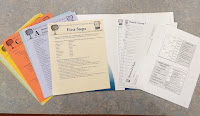
The Beginner's Genealogy Kit provided to novice family historians by the Library has undergone a transformation. Restyled as an Introduction to Family History: a guide for beginners, it has a more polished look and is now a booklet. The previous kit was a collection of handouts inserted into a folder.  
Previous Beginner's Kit


The new Guide covers the six major steps of beginning family history research:
  1. Getting Started - with whom do you start?
  2. Searching Your Home - what you already know.
  3. Write Down What You Find - forms, formats and documenting what you find.
  4. Interview Your Relatives - getting the most from their knowledge.
  5. U.S. Census Records - documents where your ancestors lived and when they were there. Contains clues as to where to look for other documents.
  6. Search for Vital Records - official documentation of the most important or "vital" events in everyone's life.
The Guide also contains many tips for organizing your records and covers special topics such as DNA Testing. 

Stop by the service desk in the Virginia Wheeler Martin Family History & Learning Center on the second floor of the Medina Library to pick up a copy or access it online at: Introduction to Family History: a guide for beginners

Considering DNA Testing for Genealogy?


With the holidays, most of the leading genealogy DNA testing companies have their kits on sale. Before you splurge for the cost of one, for yourself or as a gift, make sure you are aware of possible consequences.
On December 1st, the Library is offering a one-hour class on the basics of genealogical DNA testing, the types of tests, and a comparison of the five major testing companies: 23 and Me, Ancestry DNA, FamilyTree DNA, Living DNA and MyHeritage DNA.
Most people don't put much thought into testing before they swab their cheeks. This class urges you to think before you buy.
The class is from 6:30-7:30 p.m. 
Sign up HERE.

THE BLOG IS TAKING A SABBATICAL NEXT WEEK FOR THANKSGIVING DAY

IT WILL RETURN ON DECEMBER 1ST.


Wednesday, November 10, 2021

Medina County, Ohio's Earliest Inhabitants

by Lauren Kuntzman

November is National American Indian Heritage Month.  In honor of that, this week's blog post is about the first inhabitants of Medina County, Ohio.  

Before the first European came to Ohio in the late 1600s, at least three different cultures had previously lived in or near Medina County. These cultures did not live here at the same time, but were separated by thousands of years. These cultures are not specific American Indian tribes; rather they are people who shared unique and distinct artifacts and ways of life. These cultures included: 


Clovis Culture

Time Period: 10000 to 8000 B.C. (Paleoindian Period) (Late Ice Age) 

Characteristics: 

Presently, the Clovis culture is the earliest Paleoindian culture discovered in Ohio. The people of this culture were hunters and gatherers. They hunted now-extinct animals (like mammoths and mastodons), as well as smaller animals. They used distinctive spear points called “Clovis points” to kill their game and moved frequently, following their game and the seasons.  

Named for: An archeological site near Clovis, New Mexico, where points were first identified. 

Locally: Paleo Crossing Site (a.k.a. the Old Dague Farm Site), Sharon Center, Medina County, Ohio. An archeological site in the early-1990s, excavations by the Cleveland Museum of Natural History identified this location as a significant base camp for bands of Paleoindians.  

Wednesday, November 3, 2021

A Brief History of the First Daylight Saving Time in Medina, Ohio

 By Lauren Kuntzman


As we prepare to set our clocks back at 2:00 AM on November 7, historic newspapers help us learn how the residents of Medina fared with the first attempt at daylight saving time.  


After other countries implemented daylight saving time, the United States enacted the “Standard Time Act of 1918” (also called the Calder Act).  The act included two key elements:


  1. Standardizing time zones across the country.

  2. Enacting daylight saving time.


The two issues were entangled and led to much confusion.  


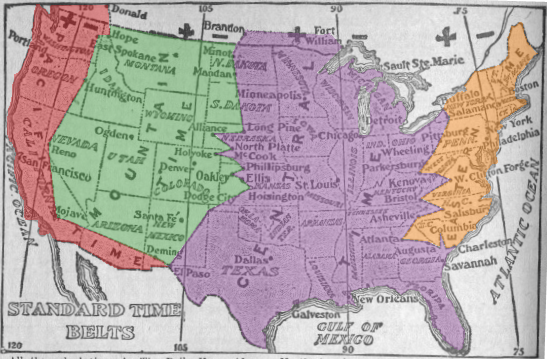
Prior to the passage of the act, Medina was in the central time zone.  The boundary was around the border of Ohio and Pennsylvania, as you can see on this map from 1913.  


1913 Map of U.S. "Standard Time Belts"


When daylight saving time was enacted on March 31, 1918, local news coverage didn’t described the change as adding or falling back an hour.  Instead it was described as changing Medina’s time zone, whether the town was following their normal central time or advancing to eastern time.  (Eastern time was also referred to as “government time.”)  


From start to finish, Medina County’s first attempt at daylight saving time seems to have been chaotic.  A Medina County Gazette headline gives us a clear indication as how the experience went, stating “Not Smoothly.”  

Medina County Gazette, 5 April 1918, p. 12.


The article from April 5, 1918, goes on to describe how much confusion the change created in Medina. 

George High's Clock, Medina, Ohio

George High’s clock (which was used to regulate the time around town) was advanced, as was the courthouse clock, the B. & O. railroad, and the electric line.  Churches, however, had not changed.  Also adding to the confusion, as the fact that many factories in the area – including A. I. Root Company, Medina Bending Works, the Henry Miller Foundry Company, and the Medina Machine Company – all changed their workers’ schedules.  This change was further complicated as the
Gazette misunderstood the A. I. Root Company’s plans and published that their schedule began at 6:30 central time when, in fact, the company intended a shift to begin at 7:30 eastern time – effectively not changing the start time at all.  


Under the Standard Time Act of 1918, daylight saving time was scheduled to end October 27, 1918.  Medina’s response was, again, one of confusion.  Town clocks, post offices, and railroads reverted back to central time, but local factories and residents wanted to stay with eastern time.  A Medina Sentinel article from November 1, 1918 describes it as an every-man-for-himself situation, and states “The result is that there is one fine mix-up, with betting odds that eastern time will finally win out.”  


Complicating matters was a discussion about the location of the line dividing Eastern and Central Time Zones. It had been suggested that, rather than the following the Ohio and Pennsylvania border, the time zone should follow the New York Central railroad line, beginning around Toledo, catching Mansfield, then Columbus, and ending in Gallipolis.  The end result was that Ohio was split into two time zones.  


A few weeks after the end of the first daylight saving time, the Sentinel announced that Medina County would become part of the eastern standard time zone on January 1, 1919.  Despite the change in time zones, at the end of March 1919, clocks were again supposed to be changed.  The Gazette reported that the second go-round of daylight saving time for Medina was not any less chaotic than the first


A few months later, in August 1919, daylight saving time was repealed.  It would be several years, before the experiment would be tried again.


Want to learn more about daylight saving time in Medina County?


Wednesday, October 27, 2021

HALLOWEEN GHOST STORIES

Halloween is almost here and it is time for some ghost stories. Let's revisit a few places in Medina County to help you get into the spirit of this spooky holiday!

Please remember these stories are just local folklore. My information is not based on fact, only hearsay and newspaper articles. However, you will see a few places that I have done some minimal research and have updated the information. 


MEDINA


The Corkscrew Restaurant fka The Burnham House

This Victorian Home has had many names in the past 130 years. It is said that Nelson Burnham built the house in the late 1880's and it was known as the Burnham Home. The interior of the house was arranged at the direction of Mrs. Burnham herself who desired the structure to be one of convenience. Through the years it has been…The Homestead Restaurant, Great Expectations, Penny’s Poorhouse and it is now The Corkscrew Saloon. The spirits seemed to start making themselves known when it was Penny’s Poorhouse. Penny Codarini, the former owner, was always happy to talk about the haunting and felt that they must be children, due to the prankish types of incidents. Her and her husband experienced moved furniture, missing items, someone walking up and down the stairs and she even heard her name being called.

 The last time I was there I heard this story…They were setting up one of the upper rooms for a private dinner party. The table was all set with napkins and silverware and when the server came back up to make sure nothing was forgotten the silverware was all a mess and salt was spread all over the table….Like Penny said…Childish Pranks!


Medina Gazette, 10 March 1882, p. 5


I did find an obituary for the original owner Mr. Nelson T. Burnham. It states he died in the home, and according to other records, just when it was being completed. Maybe he is still there....


Spitzer House Bed & Breakfast 

 Built in 1890 by Ceilan Milo Spitzer, it is said to be haunted by several ghosts. There are two haunted rooms in particular. One of the haunted rooms is called Ceilan’s Room and the second one is called Anna’s room. Anna was Ceilan's step-mother. It is in Anna’s room that a ghost of a servant girl appears on a regular basis. The dining room is also said to be haunted. The voices of two men can be heard there. Other incidences include hearing the piano play, lights turning on and off, slamming doors and light touches and taps from an invisible source.


The Medina Library 

Note: The Franklin Sylvester Room is no longer a room at the library.  A renovation was done and the resources were moved into what is now the “Local History Room”. 

The Medina Library has a century long history of serving the community. The original library was built on its current site with funds donated by Franklin Sylvester and opened in 1907. Unfortunately, Mr. Sylvester passed away in May of 1907, without getting to see his library completed. In his will, he left the library an additional $4,000. It is said that Mr. Sylvester was under the impression that the library would always remain named the Sylvester Library. However, the library is now known as the Medina Library…not the Sylvester Library. This may be upsetting to him and he likes to remind us he is still here. His presence has been felt by a few people in the former local history room and some saw a figure of a tall, dark man. You can see Mr. Sylvester’s portrait hanging above the fireplace in the 1907 room…..

The 1907 Room 

This room is the original part of the library. When a local ghost hunter group did a program here at the library a group of people went into the 1907 room. They were able to get responses to questions on a lighted meter. It seems that a young man may be in this room. Others have felt a “presence” in this room…come and see if you do.


Sérénité fka The Medina Steak House & Saloon 

Harrison Blake built the building in 1858. Over the years the building changed hands and provided different services. It was said to be a hotel, a boarding house, a grocery store, a saloon, and a steakhouse.

The former employees say the spirit here isn't mean, just mischievous. For example, silverware ended up being switched around on the tables, a plate on the wall got turned over, and sometimes spirits were seen walking through the building.


Medina Gazette, 19 Feb 1979, p. 2


Anna is said to be one of the ghosts who haunt this restaurant. She is said to be a friendly and helpful spirit. Some say that when a fire broke out on the second floor, Anna helped to contain the fire and saved the building. There are beams in the attic that still show the scars of this fire.


Medina Gazette, 9 March 1906, p. 8


I was able to find 2 Anna's connected to the building. There was a cook there when it was the Miller Hotel whose name was Anna Tibbetts. 


Medina Gazette, 24 July 1945, p. 1


The other "Anna" was a Julia Anna Miller. She and her husband, Andrew G., ran the Miller House from 1902-1917. 


LIVERPOOL


Cry Baby Bridge – Abbeyville Road

The story goes that in the 1950’s a young girl threw her baby off the bridge in an effort to hide her pregnancy. Supposedly if you park under the bridge and turn off your car it will not start again until it is pushed out from under the bridge. It is also reported that you can hear a baby crying whenever it is a silent night.


The Witches Ball – Myrtle Hill Cemetery

There are two legends associated with this grave site. The first one is that there was a witch who practiced witchcraft near Myrtle Hill and was stoned by the townspeople. The second story is that there was an insane woman who poisoned her family and threw them down a well. In either case, it is said she is buried beneath the ball and some say that she was buried standing up. They say that the ball is warm when it is cold outside and cold when it is hot outside. It also is said that snow and leaves will never fall on the tombstone. Others have reported an eerie feeling of being watched while standing near the marker. The marker is actually just a unique stone marking the final resting place for the Stoskopf family.


RIVER STYX - GUILFORD TOWNSHIP

River Styx Railroad Bridge**

On March 22, 1899, Railroad Engineer Alexander Logan ran Train No. 5 along the Erie Railroad near the River Styx Bridge, traveling at nearly 80 mph. He would never meet his destination. The engine mysteriously jumped its tracks, turned over and crushed the engineer to death. No one knows what caused the train to derail, but most agree that Logan’s heroic decision to stay on the train and steer the engine saved the lives of others on board. Witnesses say that when Logan’s body was later recovered, his hand was still clutched to the throttle. Two weeks before this tragic accident, Logan confided to his colleagues that he believed he would die on that engine. Since the fatal accident, strange events have been reported on and near the River Styx Bridge. Just a few months later a local doctor and his friend witnessed a phantom train plunge from the bridge covered in flames. They said they actually heard the passengers screaming. However, when they reached the bridge to help, the train was gone. Some have been foolish enough to walk the trestle and were cut into pieces from on-coming trains and the bridge has been the site of some suicides. In addition, a strange fog has been seen to suddenly appear, and there have been a high number of car accidents on River Styx Road below the bridge, involving people who claimed to have seen something falling from the bridge. Are all of these strange incidents related to the 1899 train disaster? Or is there something much older and sinister at work here?

**After further research it has been shown that the train accident did not happen on the River Styx train trestle in Medina County...it actually happened 6 miles south on the River Styx train trestle in Rittman, Wayne County.  Right name...wrong county. 

Cincinnati Commerical Tribune
23 March 1899, p. 1


River Styx Cemetery –  River Styx Road

Locals say they have sighted a ghost on multiple occasions at this cemetery. At around the turn of the century, a few residents supplemented their income by robbing local graves and selling the corpses to medical schools in Cleveland. Grave robbing became such a problem that the folks in River Styx started burying their dead in out-of-town cemeteries. One family even constructed an above-ground stone vault at River Styx cemetery in an effort to thwart would-be thieves. On the property is the abandoned underground vault built into the side of a hill and barred by a rusty metal gate.

I went to this cemetery to get some photographs. I had planned on entering the cemetery to take pictures, but got an uneasy feeling, and I couldn’t seem to talk myself into going past the wrought iron gate and into the cemetery. The whole time I was there it felt as if I was being watched. The brave person that I am…I quickly took my pictures and left.


HINCKLEY

Hinckley Historical Society fka The Hinckley Library 


This 1845 home belonged to Vernon Stouffer, founder of the Stouffer food corporation. It became a public library in 1973, and during renovations several staff members reported ghostly manifestations. The apparitions of a young woman in an old-fashioned blue dress and a man in a hat were seen on the stairway. A workman encountered a ghostly figure on the basement stairs. Others have felt strange presences on the upper floors and witnessed poltergeist effects, such as books being thrown off the shelves. It has been suggested that the ghosts are Orlando Wilcox and his daughter Rebecca, who lived on the site during the Civil War.


SPENCER

Spencer Cemetery - East Main Street

Spencer Cemetery is just east of the town center. Strange things are reported there from time to time--chiefly the bizarre sight of an actual, metal, real-world lantern floating free in the air as if held by invisible hands. According to local stories people have approached the lantern and passed their hands above, beneath, and around it, finding no strings or apparent trickery of any kind. Sometimes a smaller lantern is seen floating near the original.


These are just a few of the spooky places in Medina County. If you want to find more you can always check out one of the Haunted Ohio books from the library. Medina County is usually mentioned at least once in this series.

If you think your house is haunted and want to know who may be haunting it come to the Medina Library's Virginia Wheeler Martin Family History & Learning Center and we can get you started on researching your home's history.  


HAPPY HALLOWEEN!! 

Wednesday, October 20, 2021

Genealogy Slam!

 October is Family History Month
And time for the VWM Center's bi-annual
GENEALOGY SLAM!


This time of year, the Genealogy Team routinely fields questions from homeowners wishing to research the history of their home and its previous owners. Particularly those prior occupants whose presence is still felt in their home.

Join the team as we explain how to:
  • Research your home's history.
  • Research the people who have lived in your home.
  • Use maps to enhance the history of your home.

Saturday, October 30th from 1- 4 p.m.

You have the option of attending in person or via Zoom by signing up HERE.


Thursday, October 14, 2021

Get to Know Your Local Historical Societies


Medina County is fortunate to have many societies dedicated to preserving our local history.  For the third blog post in this series, we’re featuring the Brunswick Area Historical Society. Sam Boyer, the society's secretary, answered our questions about the society. 


If you are interested in local history and/or have a family connection to Brunswick, below are some details about the history of the society and the programs and activities it offers. 


MCDL Library Associate: How did the society begin? Who were some of the early members? 

SAM BOYER: The Historical Society of the Brunswick area (it’s official name) became active in 1992. There had been an attempt at starting one in the 70s, but it never really gained steam. Some of the founders included Linda Scarcella, Ellen Gibbs and Aqua Neura. Shortly thereafter, Mamie Grunau became involved as the city of Brunswick began looking for a permanent home for a historical society.
 
They purchased a farm on Laurel Road after the death of Mary Groening, who purchased the farm in 1947. The city became only the fifth owner of the property, which was first settled in 1818. It now consisted of 32 acres. There was a deed restriction as Mrs. Groening was known to have driven off developers with a broom.

The city used a federal grant to renovate all the buildings before leasing them to the society in a partnership in which the society cares for the buildings and the city takes care of the property.

MCDL Library Associate: Who are the people who manage the Brunswick Area Historical Society? And what are their responsibilities? 

SAM BOYER: Current officers include three Brunswick High School graduates – Carl Bilski, president; David Goodyear, vice president; Joyce Petchler, treasurer. I am the secretary and have been a member for a long time, but became active when former president/vice president Amber Dalakas moved to Chippewa Lake. Ms. Scarcella continues to be active; Mamie, who is 97, is still in touch but not attending meetings now.

MCDL Library Associate: Tell us about your upcoming programs?  Where/when does the society meet?  Do people have to be members to attend?

SAM BOYER: We have tried several approaches to programs and just began a series on early families who have descendants still here. We heard from Carol Gannon and Nola Benjamin Lowther about their families, and we will have a program on the Chidsey family at 7 p.m. Oct. 28 at Goodyear’s Big Barn, 691 Pearl Road.

On Jan. 28, Chrissy Rhoades, the online storyteller about historic Brunswick, will be the guest and that meeting will be held at the Brunswick United Methodist Church, 1395 Pearl Road. We plan to continue with other families. The public is invited to attend. As of now we don’t charge, but do accept donations.

During the summer, meetings are held at 7 p.m. the last Thursday of the month at the Big Red Barn at Heritage Farm.
 
To help make what is now known as Heritage Farm more visible, we started a farmers’ market and it  ended its eighth year with the fall foliage tour this year.

MCDL Library Associate: If an individual needs help with research -- or if they live too far away to visit the historical society -- how can they get assistance?

SAM BOYER: We have been offline a couple of years as we continue to work to open a new building meant to house more than 200 years of school artifacts. We will also move our office from the very crowded second floor and then will offer online and in person access. 

We are always open to conducting tours of the farm by appointment, by calling 330-441-0292 or emailing brunswickareahistory@gmail.com. 

MCDL Library Associate: How can an individual join the society?  

SAM BOYER: Information about the society, how to become a member, upcoming events, and videos of past programs are available at www.brunswickhistory.com.

See more about the Brunswick Area Historical Society by clicking on this link:  https://www.youtube.com/watch?v=j8qPTm71mi0&t=22s

Ancestry Library Edition

Please visit our new blog address at: https://vwmfhcenter.blogspot.com/    A Basic Tutorial By Lisa Rienerth Before I begin with this librar...